

BRAINTRUST, a leading consulting and professional services firm in the tourism sector, has released a new report on the meetings industry, in which it has worked for the Spain Convention Bureau for another year, analyzing the evolution of the meetings industry in 2024 and estimating forecasts for 2025 and 2026.
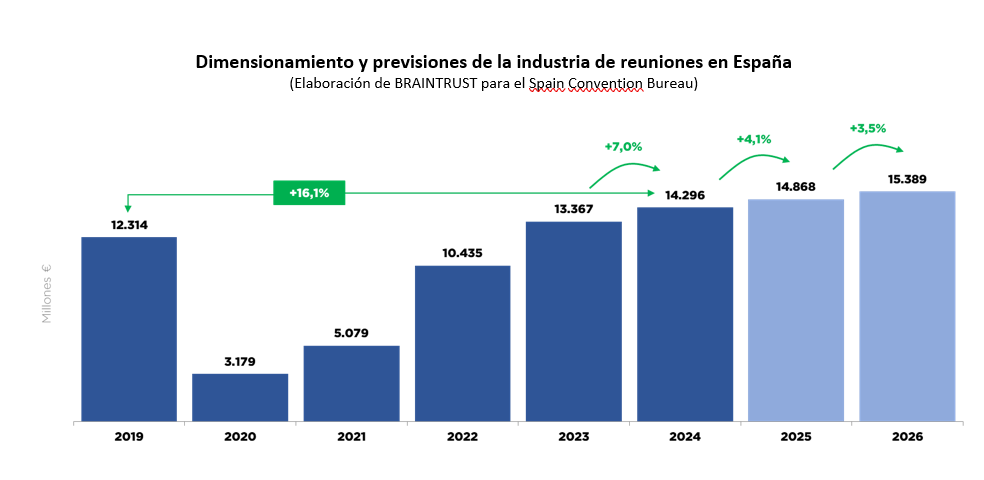
The meetings industry will reach €14.296 billion in 2024, growing 7% over the previous year and exceeding pre-pandemic levels by €2 billion.
According to data from the Spain Convention Bureau, compiled by BRAINTRUST, the network of local entities that currently brings together 65 meeting destinations within the Spanish Federation of Municipalities and Provinces (FEMP), Spain closed with a turnover of €14.296 billion, representing a 7% increase over the previous year and more than 16% over 2019, leaving any comparison with pre-pandemic spending levels behind. These figures confirm the strong pull of demand, which, combined with price increases, represents a new record figure in Spain.
In the coming years, figures are expected to continue rising, while other important objectives are pursued, such as giving meetings greater purpose and meaning for organizers and attendees, continuing to advance the sustainability of events, and incorporating and highlighting the positive impact that the meetings industry has on destinations.
In terms of passenger numbers, the data shows 10.54 million in 2024, representing a 1.7% increase on last year and a 3.2% increase on 2019. In addition, sustained growth of 1.5%–2% per year is expected in the coming years, reaching 10.91 million meeting travelers in 2026.
According to Ángel García Butragueño, Director of Tourism at BRAINTRUST: "The meetings industry is consolidating its position as a fundamental pillar of the economy in destinations, growing significantly and showing an upward trend, acting as a transformative element in the much-desired tourism model in Spain. There are now 65 destinations in our country that are part of the Spain Convention Bureau, which works tirelessly and successfully to modernize, digitize, and transform this sector that is so important for our country, focusing on excellence, innovation, sustainability, and the legacy of meetings, which already account for nearly 10% of tourism revenue, but where profitability is infinitely higher than leisure tourism. Spain continues to be a leading global destination for meetings, with several destinations already at the top of the world rankings, maximizing growth while managing its own model towards new times, establishing itself as a benchmark for sustainable industry in the broadest sense of the word worldwide.
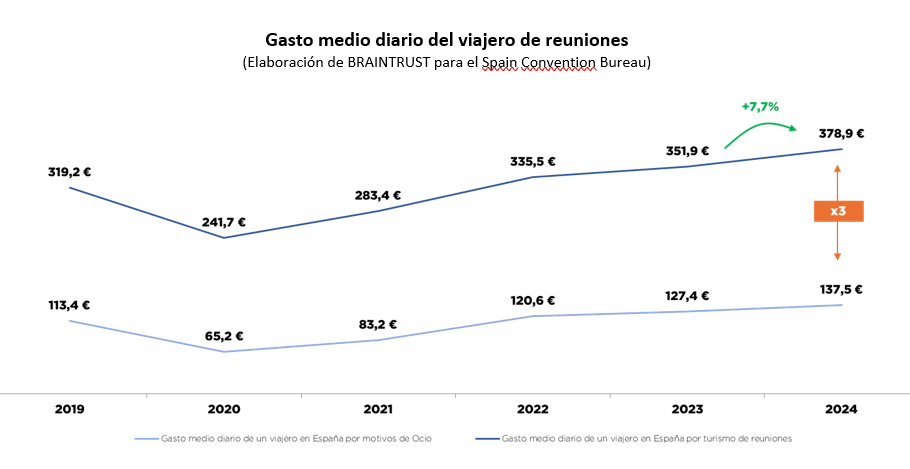
Average daily spending rises to €378.9, which is approximately three times the average spending of leisure tourists.
The average daily expenditure per traveler will rise to €378.9 in 2024, which, although mainly due to price increases, already far exceeds the expenditure in 2019, when it stood at €319.2, setting a record in the historical series analyzed. This average expenditure, which is three times higher than the average daily expenditure of leisure tourists, should convey the urgent need to communicate to all stakeholders involved in the sector in one way or another (institutions, private companies, citizens, etc.) the value of the meetings industry as a generator of quality tourism and as a driver of medium- and long-term economic, social, and environmental improvements in the destinations that promote it.
According to José Manuel Brell, Partner in charge of Quantitative Studies and Models, and the Tourism and Leisure Industry at BRAINTRUST: "The data we have been working on for the Spain Convention Bureau for another year shows us that the meetings sector continues its upward growth trend, positioning Spain as one of the most important markets globally. It is a successful model, as it acts as an economic, cultural, social, and environmental catalyst in the 65 destinations registered through the Spanish Federation of Municipalities and Provinces, where the Spain Convention Bureau is located. I believe that analyzing the data and showing its impact is critical to continuing to work in this industry, investing significantly beyond sun and sand, and making more resources available, not only human resources, but also in areas such as digitization, sustainability, and talent training. These are challenges that must be addressed in order to maintain the success of this ecosystem, which is so critical to our tourism industry."