BRAINTRUST, a consulting and professional services firm that is a leader in the tourism industry and also specializes in the hotel sector, has released new findings on the seasonality of the tourism model, its impact on accommodation, and solutions to this problem, thanks to a new wave of its Tourism Barometer.
The firm emphasizes that the new labor reform will not have an effect on the tourism industry until deseasonalization becomes a reality in our country, given the peaks that the activity suffers due to the lack of demand segmentation strategies, the lack of innovation in value propositions, and the lack of short-, medium-, and long-term strategic plans.
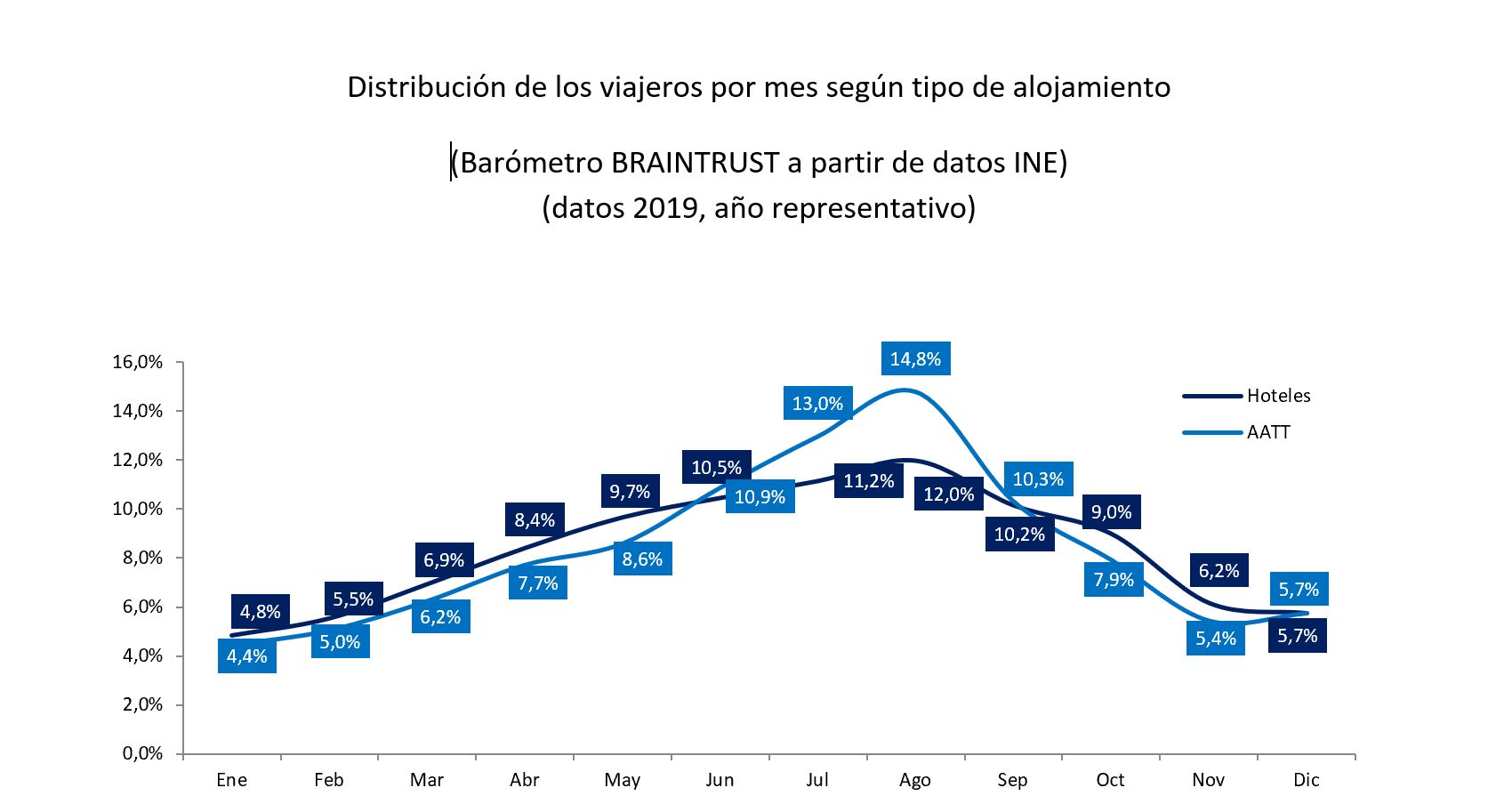
Thus, according to the graph drawn up by BRAINTRUST for a representative year such as 2019, accommodation is concentrated in the months of May to September, compared to low demand outside this period, which poses a huge challenge to the economic sustainability of the model and, therefore, to continued employability.
Economic sustainability must go hand in hand with environmental sustainability in order to achieve a profitable and balanced model.
BRAINTRUST, which assists the tourism sector with its sustainability strategies and is the author of part of the PSTDs (Tourism Sustainability Plans) currently being implemented in Spain, reveals that environmental sustainability is capturing the interest of most companies, with 75% expressing favorable opinions. However, economic sustainability is lagging far behind, despite being responsible for a profitable value model that boosts local economies and employability. In this scenario of economic sustainability, it could be a bulwark of the new labor reform, which otherwise would encounter great difficulties in an industry whose activity experiences large peaks and encourages the discontinuity of contracts, a key aspect that institutions and governments want to correct.
According to José Manuel Brell, Partner in charge of Quantitative Studies and Models, and the Tourism and Leisure Industry at BRAINTRUST: "The days of chasing international tourist records at any cost are now a thing of the past. The pandemic has given rise to new behaviors among travelers that will need to be closely monitored and acted upon quickly from a supply perspective. At BRAINTRUST, we are currently working for the industry, adapting and customizing its offerings, as knowing how to combine domestic and international tourists through effective segmentation builds a more economically sustainable model, not only for destinations but for all players in the tourism value chain."
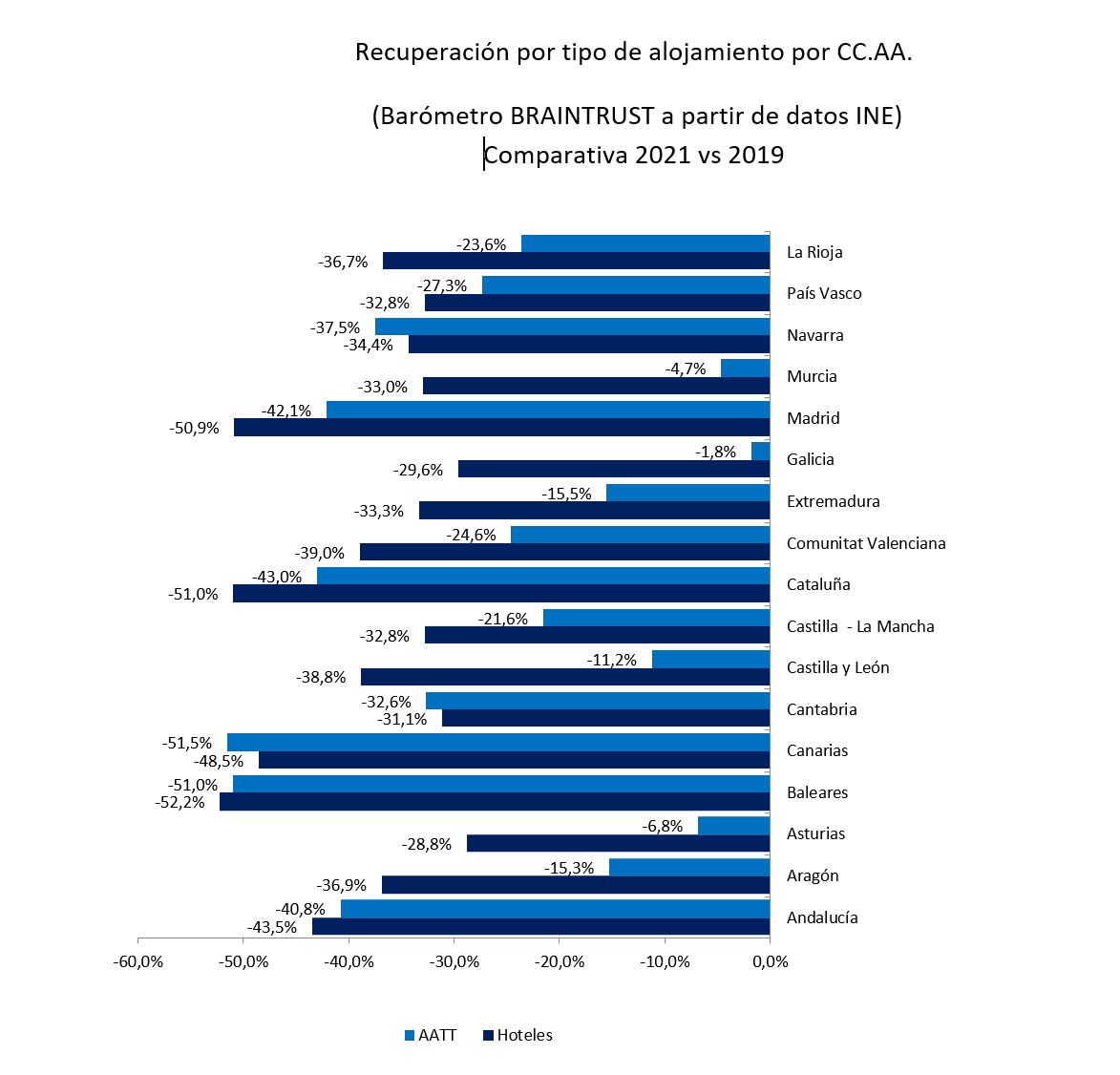
As an example of this economic sustainability, and through an analysis of the recovery by type of accommodation, it can be seen that while some regions are falling sharply in 2021 compared to 2019, others are recovering more quickly. Specifically, in terms of tourist apartments, Galicia, Murcia, Asturias, and Castile and León are very close to pre-pandemic traveler levels. These figures clearly reflect the dependence on international tourists in some autonomous communities such as the Balearic Islands, the Canary Islands, Catalonia, and Madrid, a dependence that, in times of crisis, strangles not only the tourism model but also the economy in these regions.
Although international travelers will return, domestic tourists may once again save the season and, above all, reduce the seasonality of a precarious model.
With the end of the pandemic as we know it likely approaching, interest and intention to travel for leisure is skyrocketing, reaching levels of almost 80% according to the BRAINTRUST Barometer, as three out of four Spaniards say that if the situation returns to normal and restrictions are lifted, travel will become one of the personal priorities for families, and their expenditure one of the top items in the family budget.
Domestic tourists are the ones who can bring the most balance to the tourism model, because they spread their vacations throughout the year and choose Spanish destinations for weekend trips or short stays such as city breaks. According to the BRAINTRUST Barometer, this year almost 75% of Spaniards will stay in Spain, even if international restrictions are lifted. This desire is accentuated by the intensive promotion of destinations in our country since the arrival of the pandemic, knowing that it is more difficult to attract foreign travelers and even more so tourists from far away, who are so desired by large cities such as Madrid and Barcelona because of their greater purchasing power and higher average value per trip.
The hotel sector is unsure whether the changes brought about by the pandemic will be temporary or structural.
José Ignacio Sánchez Butragueño, Director of Hospitality and Leisure at BRAINTRUST and a leading industry expert, concludes that the hospitality industry is at a turning point from which it must emerge stronger, thanks to the definition of short-, medium-, and long-term strategic plans capable of addressing the major challenge facing tourism in Spain: recovering demand while transforming the industry. For Sánchez Butragueño, the data for 2021 is not entirely representative, but it does show valid trends from which interesting conclusions can be drawn. Hoteliers cannot sit back and wait for everything to return to the way it was before. It is time to diversify and adapt the range of hotels and brands, redefine the value proposition, and maximize profitability through an optimal mix of segments and channels, pricing strategies that capture the full potential, and the generation of new sources of income. The expert states that the keys are innovation, sustainability—economic, social, environmental, and territorial—and a focus on profitability through higher ADR (average daily rate) to design a new era that will once again allow Spain to lead tourism in the future. These are keys that BRAINTRUST is working on for the entire industry and all its clients, the players in the entire tourism value chain.