

BRAINTRUST brings us a new wave of its Tourism Barometer, an analysis of sustainability in the tourism industry. The concept of sustainability, which appeared a few years ago as a "new trend," is gaining strength and importance at many levels and in many sectors around the world. In the case of the travel sector, which had been working on the implementation and development of the concept of sustainability throughout its value chain for several years, the situation caused by the pandemic has only accelerated this process, highlighting the importance of offering safe, sustainable, and respectful destinations to guarantee the quality and survival of tourism in the years to come.
The concept of sustainable destinations from the tourist's point of view
The BRAINTRUST Tourism Barometer reveals what visitors consider to be the meaning of sustainability in a vacation destination. Among the various concepts analyzed, the fact that the destination respects its environment is the main definition of sustainability for the vast majority of domestic tourists (75.7%).
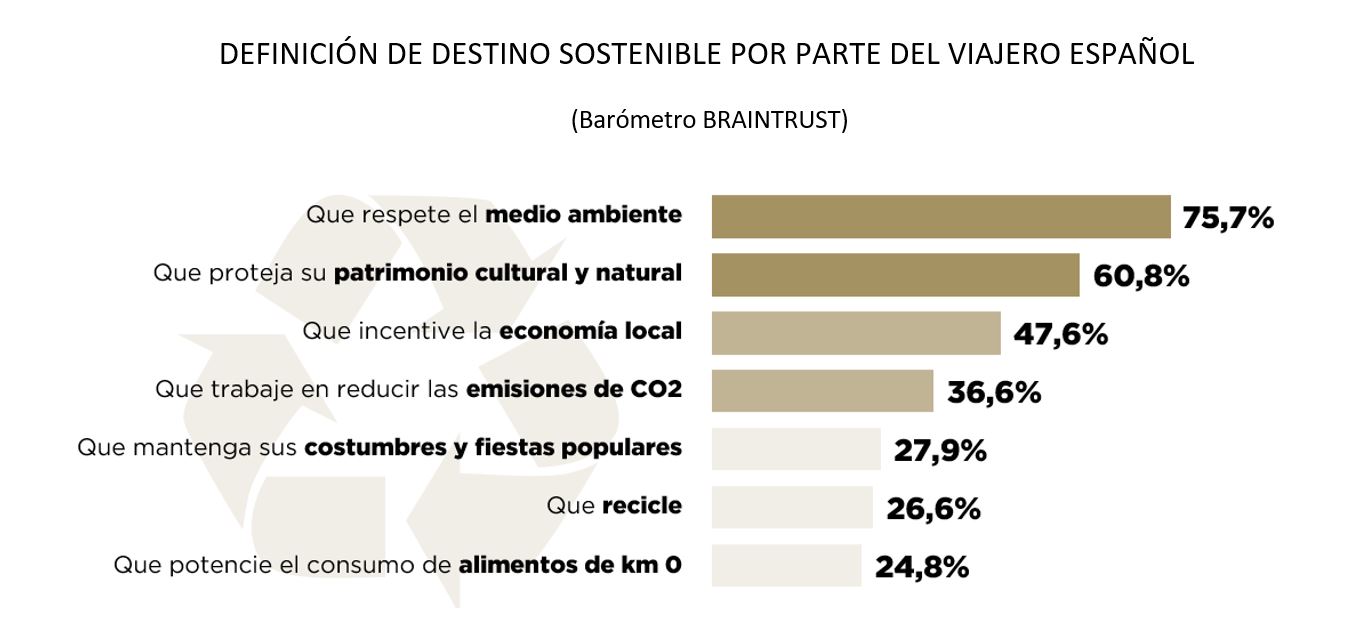
The protection of cultural and natural heritage is also closely linked to the concept of sustainability for travelers (60.8%), followed by boosting the local economy (47.6%) and working to reduce CO2 emissions (36.6%).
Other actions taken by destinations to make them sustainable, such as preserving their customs and popular festivals (27.9%), recycling (26.6%), and promoting locally sourced food (24.8%), are the terms that Spanish travelers least associate with sustainability today, although these factors will also increase in importance in the coming years.
For Ángel García Butragueño, Director of Tourism at BRAINTRUST, "We continue to associate sustainability almost exclusively with the environment. Of course, this is fundamental, but we must not forget that it is a term that should also encompass other aspects and actions that help us to 'take advantage' of the environment in a responsible and respectful way with a view to its conservation in the future. At BRAINTRUST, we help destinations and all stakeholders in the ecosystem to develop these actions, as we believe that extending sustainability to all areas, whether environmental, economic, sociocultural, or territorial, is what will help tourism to recover and survive year after year. This is the path for tourism in Spain: to move from a massive and invasive model to a model based on value and respect, which will allow tourism to endure and continue to be world leaders in a post-pandemic future, in a country where tourism accounts for 12% of GDP and 15% of employment under normal conditions. Now is the time to take advantage of the Next Generation European funds for this purpose, as a key part of the Plan for the Modernization and Competitiveness of Tourism of the Secretary of State for Tourism.
The importance of sustainability in choosing destinations
In an assessment of the aspects that travelers consider most important when choosing where to spend their vacations, BRAINTRUST analyzes the position of sustainability among many other points.
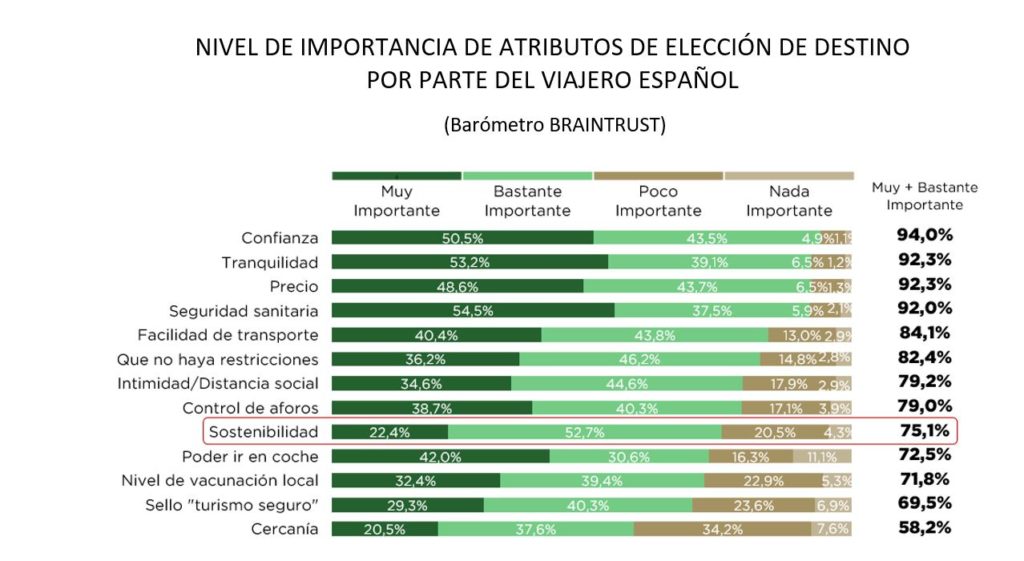
Due to the pandemic situation we have been experiencing since last year, our priorities and needs have changed in many ways, including when it comes to traveling. It is therefore not surprising that factors such as confidence in the chosen destination, peace of mind, and health and safety are the aspects that travelers consider most important when choosing where to spend their vacations.
Of all the key aspects that tourists consider when deciding where to visit, sustainability ranks very highly alongside other important factors in the current COVID-19 situation, such as social distancing and capacity limits. This gives us a clue as to the value and consideration that travelers place on destinations (and providers) that care for their natural, cultural, and social environment, or in other words, the growing importance of sustainability in the tourism sector.
For José Manuel Brell, Co-Director of the Tourism Barometer and Partner responsible for industry at BRAINTRUST, "The pandemic situation has made us realize that sustainable tourism is no longer an option but an obligation. The arrival of the virus has made us more aware of the need to take care of our surroundings, to have clean, natural, and sustainable spaces; to take care of local economies that have suffered so much from this crisis and to value more than ever the ability to enjoy places beyond the walls of our homes, where we have had to spend so much time over the last year. In order to enjoy all of this, we must make destinations sustainable. Tourists do not want overexploited and saturated destinations, but rather destinations that preserve their environment, culture, and economy, to which they can return year after year. And in this context, the entire industry value chain must get its act together and not treat sustainability as a fad, but as a vehicle for transforming and strengthening a medium- and long-term model that ensures greater durability and profitability.
Sustainability in Spain's autonomous communities
Tourists are becoming increasingly demanding when it comes to sustainability, whether choosing a hotel, transportation, products, services, etc. The same will happen when travelers choose which destinations to visit, which is why more and more autonomous communities are deciding to take action and implement measures and develop projects in which the concept of sustainability is becoming a priority.
In the latest edition of its Tourism Barometer, BRAINTRUST ranks the autonomous communities most committed to sustainability in the eyes of Spanish travelers, who share their perceptions of the most sustainable region.
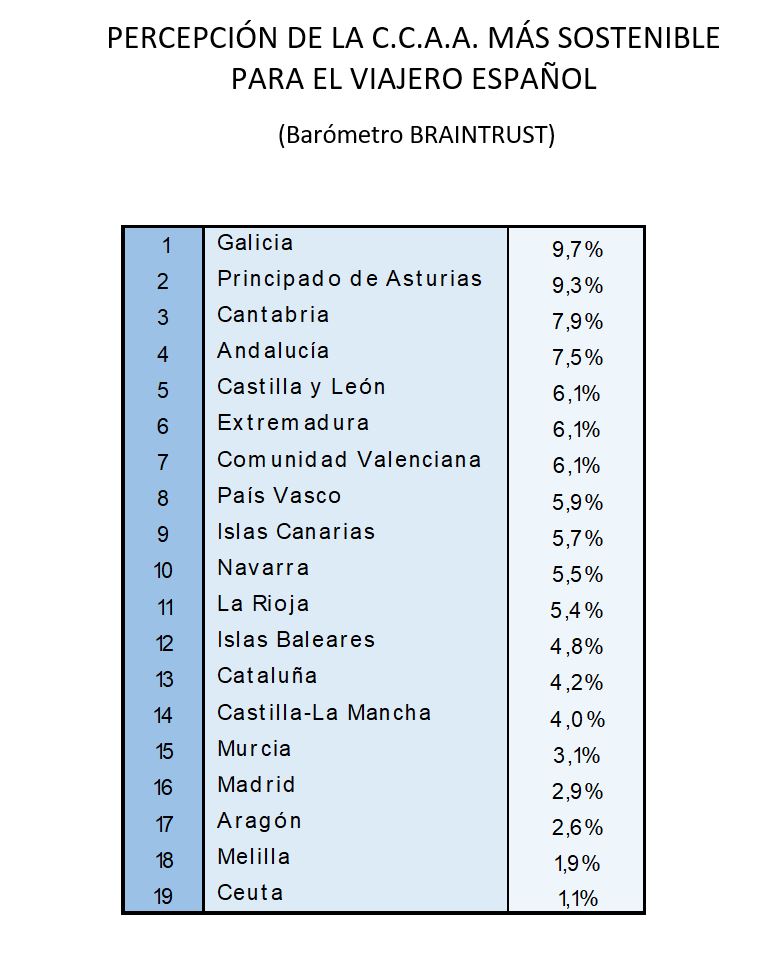
9.7% of Spanish travelers consider Galicia to be the most sustainable region in Spain, closely followed by Asturias (9.3%), Cantabria (7.9%), Andalusia (7.5%), Castile and León (6.1%), Extremadura (6.1%), and the Valencian Community (6.1%).
On the other hand, domestic tourists believe that the areas with the most room for improvement in this regard are Ceuta, mentioned as the most sustainable by only 1.1% of travelers, Melilla (1.9%), Aragon (2.6%), Madrid (2.9%), and Murcia (3.1%).