
The consulting and professional services firm BRAINTRUST, a leader in the tourism sector, has released a new report from its Tourism Barometer, which takes an in-depth look at the source market and the capacity for deseasonalization of tourism models other than sun and beach, which would help manage destinations in a more sustainable way from an economic and social point of view, and thereby improve residents' perception of tourism in these times of animosity towards the industry in some mature destinations around the world.
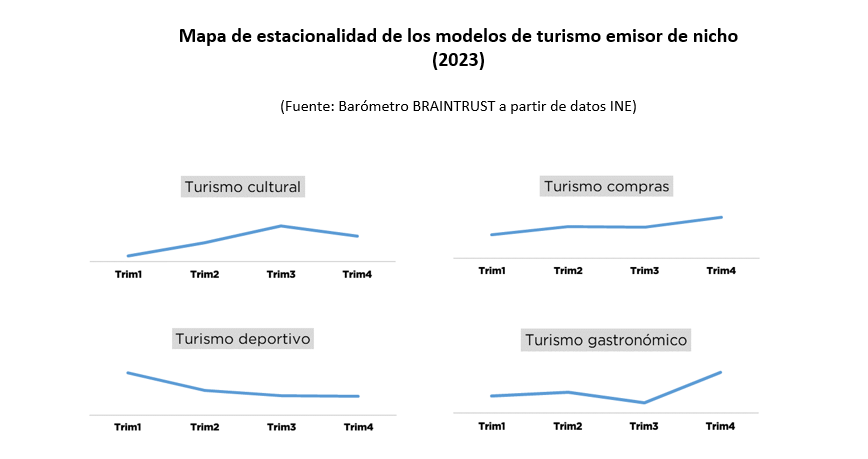
Sun and beach tourism is highly seasonal, while culture, shopping, sports, and gastronomy offer destinations the ability to deseasonalize their model.
In its detailed analysis, BRAINTRUST has developed a seasonality index for domestic tourists and their spending by type of tourism, identifying those with the greatest potential for economic sustainability and employability. This index is calculated by taking into account spending during the high season and comparing it with spending outside this period, yielding a seasonality indicator, which is then categorized into three types of risk: high when activity is mainly concentrated in the summer months, medium when it is usually grouped between summer and spring, and low when it is distributed more evenly throughout the year.
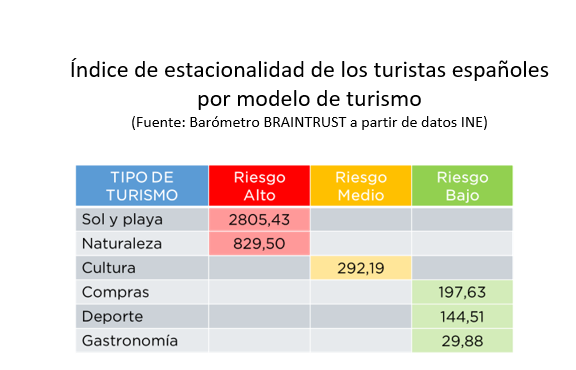
Sun and beach tourism has the highest seasonality index, reflecting the fact that Spanish spending on this type of destination is not spread throughout the year (69.8% of this spending is concentrated in the third quarter), meaning that there is room for improvement in terms of its economic and social sustainability. The consulting firm warns that this model, while still important due to its weight, makes the activity precarious and prevents the deseasonalization that is so damaging to some mature destinations, not only in Spain but worldwide.
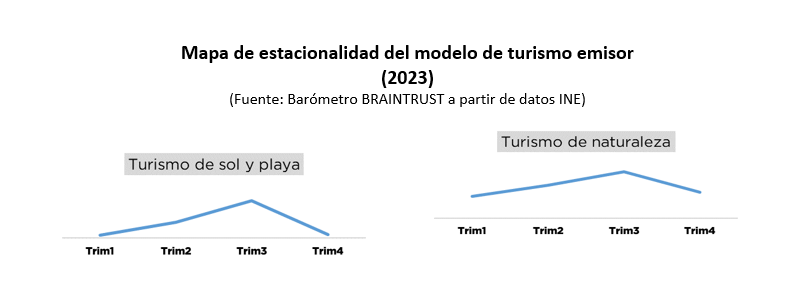
This sun and beach tourism is concentrated in a few months (the summer months), as reflected in the distribution of spending in this type of destination by quarter. Nature tourism, although to a lesser extent, also has a high seasonality indicator. The summer period also accounts for the highest volume of tourist spending.
According to data from BRAINTRUST, domestic travelers are increasingly considering other types of tourism that are more innovative than sun and beach vacations, which, although still popular, are gradually losing market share, especially with the incorporation of younger generations who seek memorable experiences through new concepts such as traveling to discover and taste local cuisine, shopping, participating in different sports competitions, or learning about the native culture. These practices tend to be more evenly distributed throughout the months than other models (as can be seen from their seasonality indices), offering destinations the opportunity to deseasonalize their model, creating greater economic wealth and decent, long-term employment throughout all seasons, as opposed to the precarious employment of the sun and beach model.
According to Ángel García Butragueño, Director of Tourism at BRAINTRUST:"After the pandemic, and following the window of opportunity that opened up to change the tourism model, we realized that we could be missing out on the chance to create and manage a more sustainable industry. In Spain, we continue to exploit the sun and beach model, when we have an excellent offering that we can communicate, where other increasingly important niches are located, such as culture, sports, shopping, and nature. These are tourism models that are capable of deseasonalizing spending throughout the year, allowing destinations to create greater wealth and employment. These types of tourism activities will continue to grow, and they must be enriched, promoted, and managed. I wonder if the PSTDs (Destination Tourism Sustainability Plans), on which we have spent billions, in addition to beautifying destinations, include the use of business intelligence and data analysis to promote this type of tourism and facilitate the change of model, or if they have been a waste of money to continue showing Spain only as sun and beach. The protests against tourism are calling for exactly this: for the model to be much more sustainable and to benefit residents with a much more diversified, seasonally adjusted, respectful form of tourism that brings greater benefits to the destination.
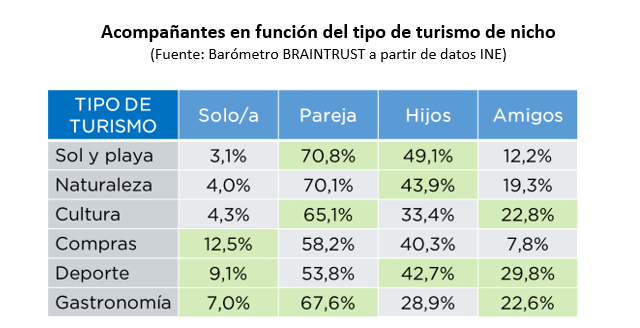
Sun and beach with the family, culture with your partner, sports with friends, and shopping alone
BRAINTRUST has also analyzed the different types of niche tourism, reaching some significant conclusions that should be taken into account when customizing the value proposition. They state that sun and beach tourism tends to be mainly family-oriented, accounting for 49.1%, while culture shows different results, with couples accounting for a significant 65.1%, sports involving friends at 29.8%, and shopping being the niche with the highest percentage of solo travelers at 12.5%.
According to José Manuel Brell, Partner in charge of Quantitative Studies and Models, and the Tourism and Leisure Industry at BRAINTRUST: "Tourism continues to grow unabated, as we predicted in previous reports, and the outlook for Spain is very optimistic, given the current economic and geopolitical situation. However, there are beginning to be some signs of fatigue among residents regarding the negative impacts of tourism, which could become widespread and need to be managed. In Spain, we have the opportunity to diversify our value proposition through different niches, which are a great opportunity for the future. We cannot continue to rely on sun and beach tourism, because we will have wasted the opportunity to position ourselves as a diverse, hospitable, and safe, where all types of tourism have a place, which, among other things, generate greater spending, with positive externalities such as the creation of sustained employment, the fight against depopulation in inland Spain, and better conservation of objective resources that we must all address, and which will be key to our country's model in the coming decades. Analyzing the data and drawing business conclusions and recommendations for continuous improvement is everyone's job, and at BRAINTRUST it is our responsibility to contribute ideas, resources, and projects for transformation.