

The consulting and professional services firm Andersen Consulting (formerly BRAINTRUST), a leader in the tourism sector, has released a new report from its Tourism Barometer and announced a new record for Spanish tourists' holiday spending.
According to data provided by the consulting firm, provided that the macroeconomic environment and geopolitical situation do not take a turn for the worse—especially in an era of potential tariff conflicts, the impact of which on European economies is still unknown—holiday spending will exceed
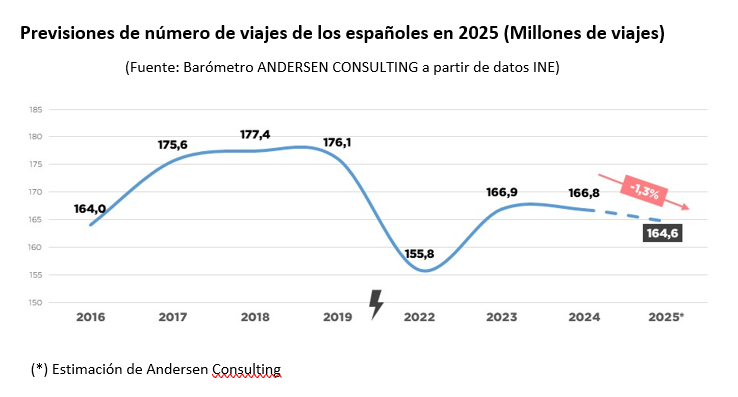
all forecasts, although the number of trips will fall slightly (by 1.3%).
Spending exceeds all forecasts, reaching nearly €55 billion.
According to data from Andersen Consulting, which, through its Tourism Barometer, once again takes the temperature of the market and announces its forecasts, which serve as an observatory for all public and private bodies in the industry in Spain, with a view to making appropriate decisions, spending records will be broken once again this year.
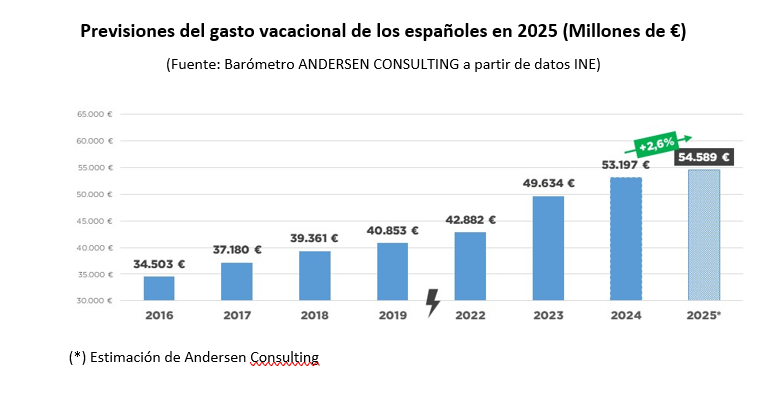
Specifically, in 2025, Spaniards would spend 54.589 billion on everything related to vacations, always from the point of view of the issuer, that is, including the spending of Spaniards in our country and the spending of Spaniards abroad. Therefore, this figure adds up domestic and international trips made.
Growth would exceed the previous year's figure by 2.6%, when €53.197 billion was achieved, and would far exceed 2019 levels, when spending stood at €40.853 billion. Effects such as structural price increases offset the decline in inflation, with extremely high and robust demand and greater internationalization of travel continuing to drive spending figures.
The consulting firm also breaks down this data, stating that spending on domestic travel would represent 67.7% of the total this year, compared to 32.3% for international travel, which is gaining momentum as new generations enter the market, more accustomed to traveling, less fearful, and with greater technological and language skills. This trend will continue in the coming years as older generations, who generally stayed in Spain, leave the travel market.
According to Ángel García Butragueño, Tourism Partner at Andersen Consulting: "Our data once again points to another record in outbound tourism in Spain, a phenomenon that, barring unusual circumstances, will continue to occur consistently, demonstrating that tourism is an economic driver for the Spanish economy. If we add to this spending by Spaniards another record in spending by foreigners in Spain in 2025, a figure we announced a few weeks ago,
These forecasts will depend heavily on the current geopolitical situation, and although Spain has been relatively unaffected by the "tariff war," there is no doubt that it would psychologically affect households' willingness to spend on travel in our country.
However, considering the current situation and purchasing power following interest rate cuts, we are optimistic and believe that, although there may be some reluctance to spend, higher-value trips will continue to rise, supported by higher-income households, along with a widespread desire among tourists to enjoy different experiences, unique trips that involve greater expenditure, and where we are also seeing a return to the use of intermediaries, specifically travel agencies, provided that they move away from traditional marketing and become retailers adapted to the new times.
At Andersen Consulting, we closely monitor the analysis of tourism data with a global vision, as we advocate for a sustainable industry in the broadest sense of the word, from an economic, social, and environmental perspective. Data must be viewed as a whole if we want to define policies that make sense in the short, medium, and long term.
The number of trips falls slightly, driven by macroeconomic uncertainty and certain changes in household habits.
Andersen Consulting has announced a slight decline in the number of trips, reaching 164.6 million in 2025, which would represent a 1.3% decrease from the previous year, when there were 166.8 million trips in total.
Some reasons behind these declines (which already seemed to be anticipated in 2024) could be the loss of purchasing power due to inflation, which, despite having fallen, still persists, and, obviously, geopolitical uncertainty.
However, it has also been observed that the number of international trips is increasing (both short, medium, and long distance), so it seems that part of the reduction may be due to certain changes in travelers' behavior patterns, with a greater number of domestic trips being replaced by a (slightly) smaller number of international trips.
Andersen Consulting reinforces the idea that travel has become a way of life for all generations, who, in the wake of the pandemic, now form a society that spends more on life experiences than on accumulating goods.
According to José Manuel Brell, Managing Director and Partner at Andersen Consulting, "Outbound tourism is once again exceeding previous spending figures, as we have been announcing for some time, given that travel is a priority expense for Spanish families.
However, it is necessary to closely monitor the data and interpret it in business terms. While spending is rising, the number of trips is falling, which leads to specific analyses that are worth knowing, such as who is spending more and why, and who is spending less and why. This will enable tourism companies to define policies that optimize opportunities.
At Andersen Consulting, we conduct a daily analysis of the sector, looking at what is happening, how spending is distributed, who is generating it, which destinations are most in demand, what type of travel is chosen, through which channel, the types of transport, and the categories.
accommodation, we are able to help public and private companies determine future strategies.
Analyzing, interpreting, and evaluating data, as we are doing once again at Andersen Consulting, reveals the keys to the decisions that must be made by managers.