BRAINTRUST, a leading consulting and professional services firm in the tourism industry, has presented its report on Reactivation Strategies for the meetings industry, entitled "Spain, where meetings build sustainable value," at an event held at the Spanish Federation of Municipalities and Provinces in Madrid, attended by prominent figures from the industry in our country.
Augusto Hidalgo, Mayor of Las Palmas de Gran Canaria and President of the Spain Convention Bureau (SCB), the section of the FEMP that brings together destinations promoting meetings tourism or MICE tourism, and the Deputy Director General of Tourism Development and Sustainability of the State Secretariat for Tourism (SETUR), Ana Muñoz Llabrés, presided yesterday, Wednesday, over the presentation of the study on Meetings Tourism and the strategy for its reactivation, held at the FEMP headquarters.
A MICE industry that is expected to recover around 2024
The study, funded by SETUR, looks at the situation facing the meetings, incentives, conferences, and exhibitions (MICE) tourism sector in our country after the pandemic, analyzes the recovery experienced over the last year, and proposes strategic lines for its reactivation. According to the study's conclusions, the economic impact of the MICE industry in 2019 reached €12.3 million. The pandemic brought a 75% drop in 2020 and an economic impact of €5.079 billion in 2021. Depending on the evolution of the pandemic or other events, a return to 2019 levels could be achieved in 2024, although a significant upturn would be possible after the second half of 2022 if the situation stabilizes.
A shared vision for the future, for an industry that sets an example and model for sustainable tourism
According to Angel García Butragueño, Co-Director of the Tourism Barometer and Director of Tourism at BRAINTRUST: "There is a clear vision of where the meetings industry should be heading, the best example and model of sustainable tourism in our country. This vision is shared by all players in the value chain, both in the public and private sectors. The meetings industry in Spain must position itself as a world leader through an innovative and scalable business model based on public-private collaboration, placing it within a framework of sustainability that promotes integration between visitors and residents. It must take advantage of the vast opportunity for multi-sector business and growth in global demand that the post-pandemic era will offer to destinations that know how to contribute to their customers' goals. The Spain brand has incalculable value that must be transferred to the MICE segment through joint and collaborative work between institutions and all members of the ecosystem, personalizing an excellent and innovative omnichannel experience for each user and highlighting its extensive and diverse local wealth. To this end, it will offer the latest technology at the service of the best professionals, generating benefits for all stakeholders, while caring for the environment and maximizing the return for both the customer and the territory, leaving a positive legacy for citizens.
Strategic framework for the reactivation of the Meetings Industry
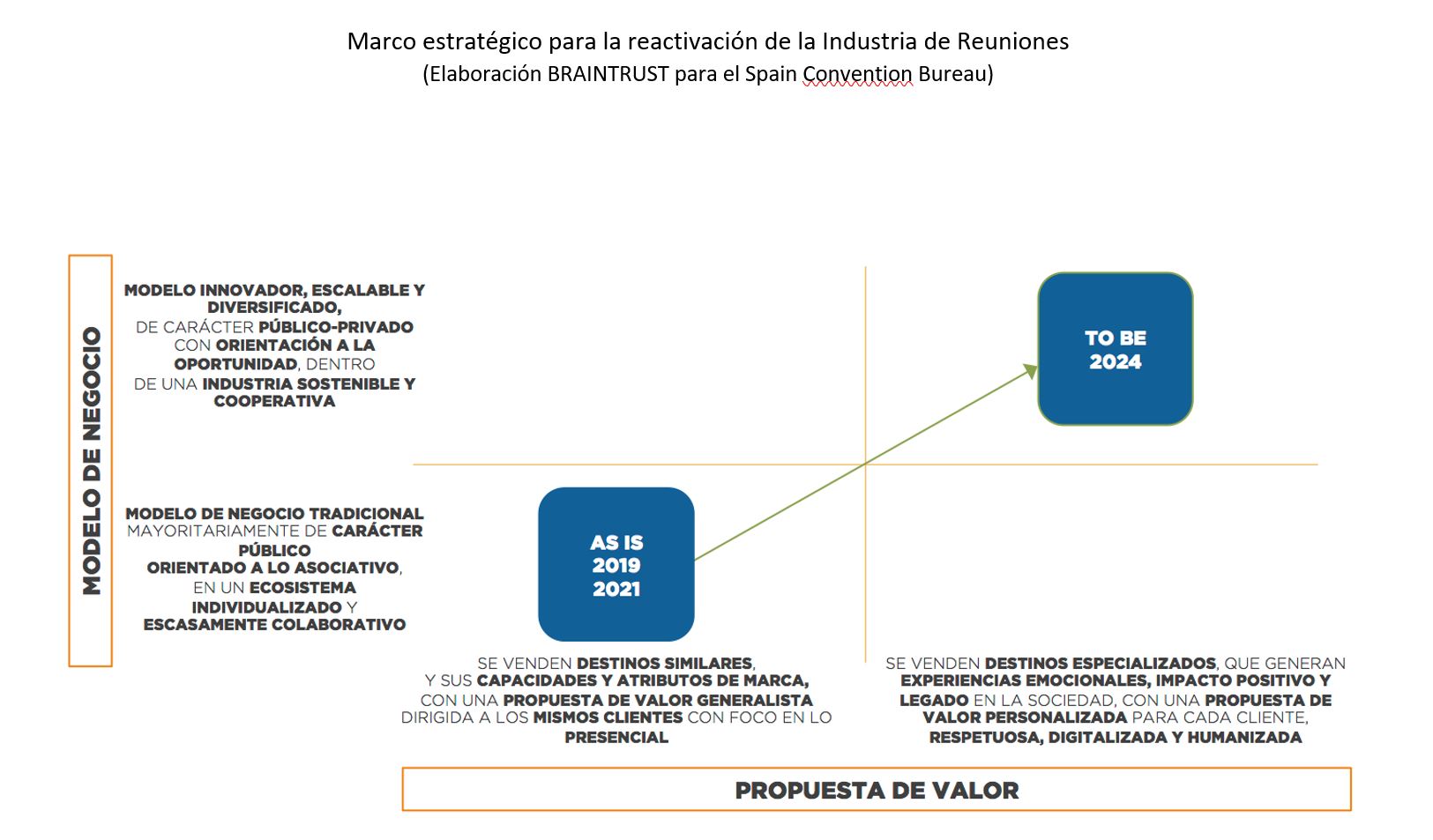
Four strategies and 20 lines of action to revive a key sector for Spain's tourism and economic model
As for the strategy to revive this industry, which is key to our tourism and economic model, the study concludes that destinations must transform and adapt to the new needs demanded by the market, which include specialization, diversification, sophistication, and transformation to become more efficient and profitable. In fact, the proposed strategic program is divided into four lines of action: securing the business; rebuilding the ecosystem; developing the new model; and measurement and continuous improvement. Each of these lines includes actions such as bringing the "Marca España" brand to the MICE sector, working to preserve the environment, and making the most efficient technologies available to the best professionals.
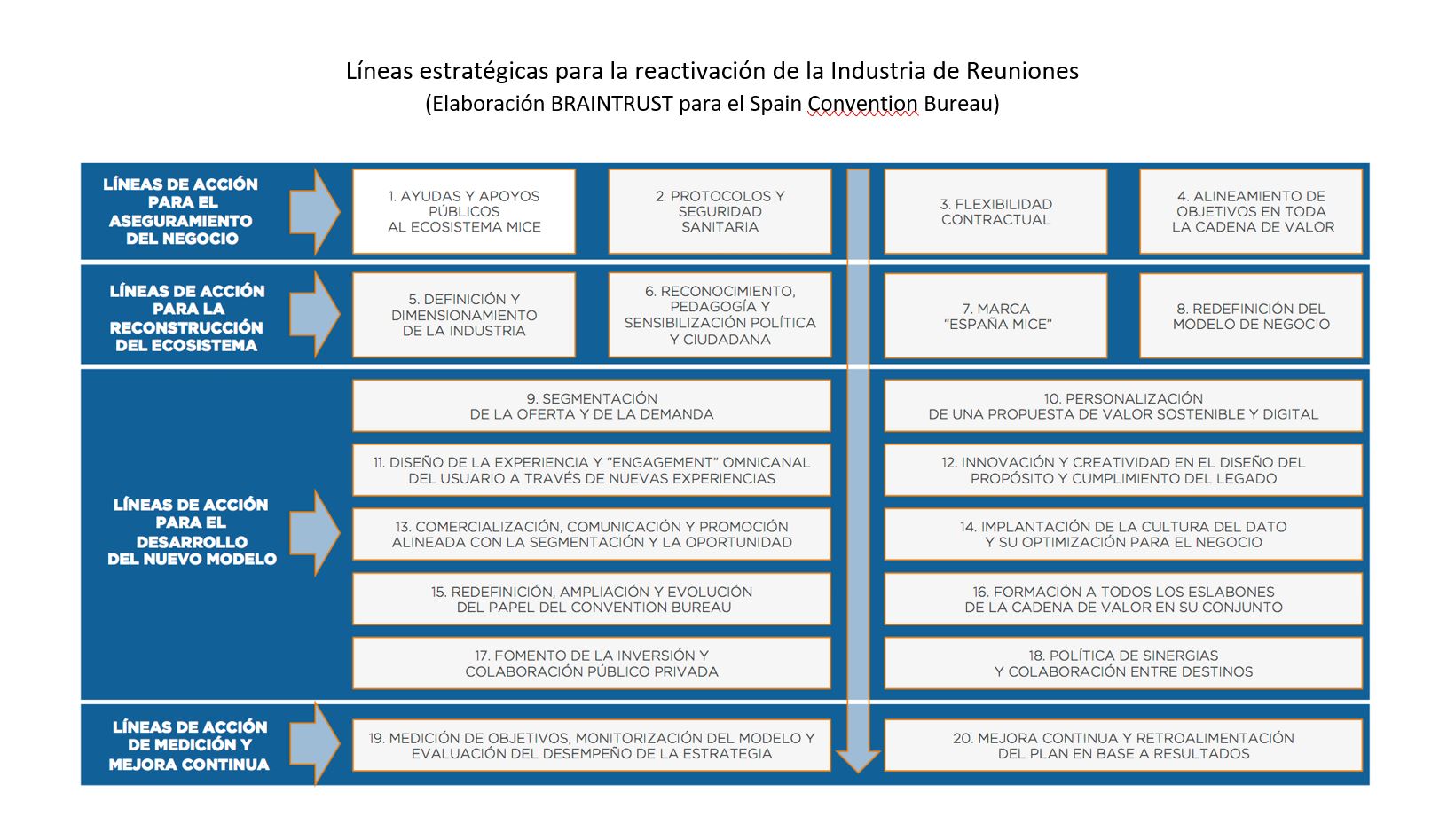
According to José Manuel Brell, Partner in charge of Quantitative Studies and Models, and the Tourism and Leisure Industry at BRAINTRUST: "The meetings industry in Spain is at a crossroads, with the main challenge being to recover demand while transforming supply, evolving the model, expanding public-private collaboration, diversifying the business, and training professionals in new skills needed to address a future that is still uncertain and unpredictable, although it will generate multiple opportunities if the recovery plan is implemented. A goal without a plan is simply a wish, and at BRAINTRUST we are helping the Spain Convention Bureau and its 58 member destinations to make this Recovery Plan a reality, which we are very proud to have developed together with the public and private sectors."