
Twenty-nine signs are enough to construct the world we know, and in some languages, such as English (which is the case we are dealing with today), we need no more than 26. These are the letters of our alphabet, with which we build words following a kind of orderly chaos and random cultural heritage in which we are able to understand each other, communicate, explain ourselves, and create new realities or describe those already created.
Letters also serve to create acronyms and initialisms as a way of shortening names and expressions that always follow the same sequence of words. These can in turn lead to neologisms, known as acronyms, when their pronunciation becomes standardized to the point that they end up having an intrinsic meaning, as in the case of "UFO."
In the business world, acronyms also serve a formal function, in that they allow certain concepts to be referred to quickly in order to focus attention on the objectives of each company and campaign. This is also noticeable in the field of Customer Experience, as one would expect from one of the disciplines with the most promising future. With such a promising future, the only way to survive in a more unstable and uncertain environment will be to redouble our known and yet-to-be-discovered efforts in CX.
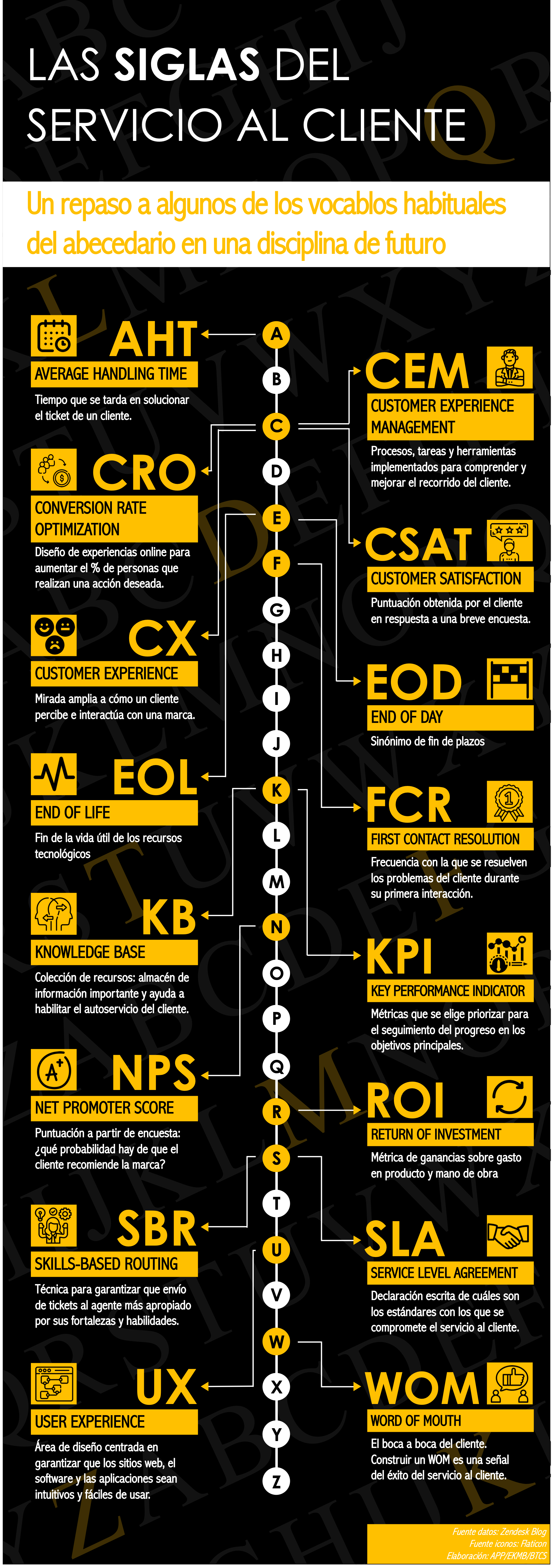
At BRAINTRUST, based on a recent post on the blog of the specialist company Zendesk, we wanted to bring together some of these voices and present them in the form of an infographic, to offer our readers a visual and practical tool that allows them to quickly identify some of the most common terms in the sector. This is the essential alphabet of Customer Experience.
Photo by Jessicah Hast on Unsplash
Prepared by: APP/EKMB/BTCS