It seems clear, as BRAINTRUST has already indicated in previous analyses, that domestic tourism will be key to recovery from the crisis and that Spaniards will seek destinations far from large crowds that they can reach with their own vehicles. But what destinations will they choose for their next getaways and vacations? What type of trip will they opt for?
In a new wave of its Tourism Barometer, BRAINTRUST reveals what these travel trends will look like by type of traveler and what the first steps could be, both for local and regional governments and for tourism companies such as airlines, hotels, car rental companies, tour operators, and travel agencies, in order to adapt to them.
TRAVEL PROFILE BY TYPE OF TRAVELER
A comprehensive analysis of sociodemographic data by gender and age, carried out by BRAINTRUST, reveals significant differences between the profiles of travelers who are more likely to choose one type of destination over another, also adapting their preferences to the new situation caused by the COVID-19 crisis.
On the one hand, more men will choose their trips based on gastronomy and, in particular, locally sourced products that help to boost the local economy (57.8%), while women will be slightly more likely to choose a destination seeking culture and heritage away from crowds (51.6%), nature and, specifically, more secluded destinations (51.9%), and shopping, especially for artisanal and local products as a sign of solidarity (52.3%). However, the biggest difference between the sexes is found in spa and wellness tourism, which will be much more in demand among women seeking these types of pleasures that they have been unable to enjoy during lockdown (61.5%).
Focusing on the age of travelers, we observe that those belonging to Generation X (between 40 and 55 years old) will account for 38.4% of cultural and heritage trips within Spain, 48.2% will choose nature tourism, 42.5% will choose gastronomic trips, and 46.7% will choose shopping trips. Spa and wellness tourism will be the preferred choice for BBs (over 55) (41.6%), as will religious trips, which will account for 32.4% of travelers in this generation, with greater caution and respect for the possibility of infection once the lockdown has been lifted.
When we analyze younger people, i.e., those belonging to Generations Z and Early M (those under 30), the most popular destinations will be sun and beach destinations, with 20.7%, as well as sports tourism, which will account for 27.3% of their trips.
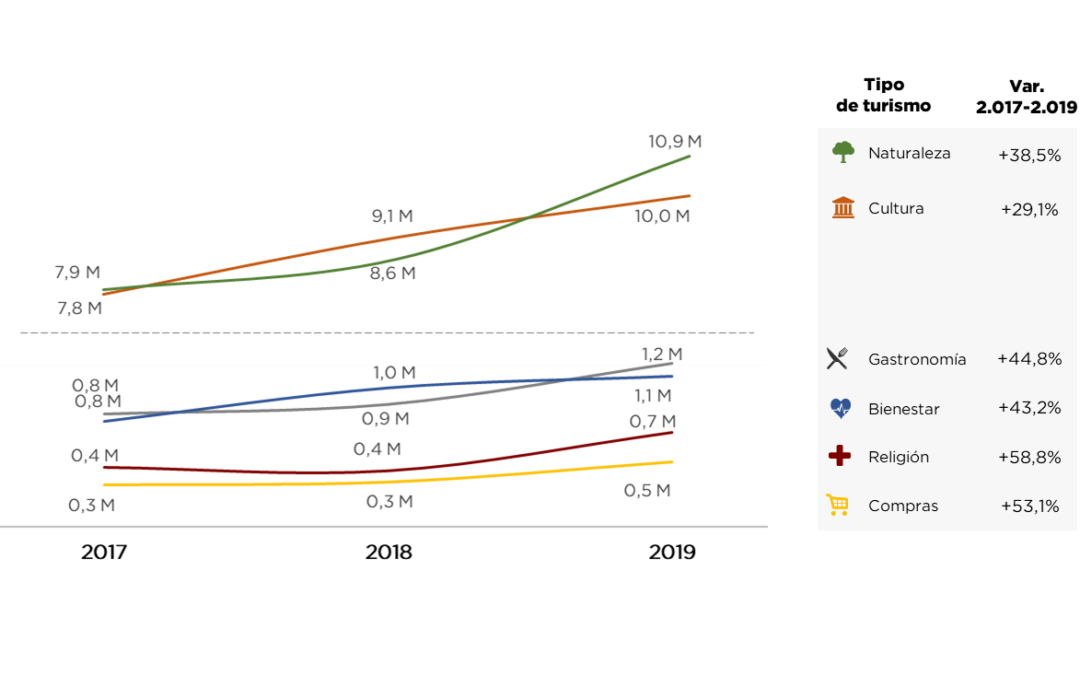
The study of data trends over the last three years carried out by BRAINTRUST's Tourism Barometer shows that these new trends coincide with two of the types of travel that have seen the greatest increase in numbers: nature tourism (with growth of 38.5% since 2017) and cultural tourism (29.1%).
All these trends are becoming more pronounced, and show that different types of tourism will be sought after in the coming months, rather than just sun and beach tourism. In line with the growth experienced over the last three years, we are referring to types of tourism such as gastronomic experiences (with a 44.8% increase compared to 2017), after so many home-cooked meals since March, health and wellness experiences after a long period of routine (43.2% increase), and shopping tourism, which will help boost activity after the economic hibernation (up 53.1%).
THE REACTIVATION OF THE SECTOR
In the current situation we are experiencing due to the COVID-19 crisis, we can predict which types of tourism will be strengthened and which will see their growth of recent years slow down after this pandemic.
Everything indicates that nature tourism will become more prominent as it offers open spaces and fewer crowds of tourists. In fact, rural house rentals have increased in recent weeks ahead of the summer season, as, among other reasons, they may be seen as somewhat safer by some travelers, compared to hotels, which will have stricter protocols once they are approved by the ICTE and progressively implemented.
To promote cultural tourism in Spain, which is highly valuable as it is one of the sectors that has generated the most expenditure in the last year (€3,014.7 million in 2019), various initiatives have already been launched by local councils and tourist offices, some of them with the help of BRAINTRUST, to revive the sector, with budget allocations earmarked for aid to the sector, as well as the design of "roadmaps" to help offer quality tourism and the necessary health measures throughout the ecosystem.
Sun and beach tourism, so important for coastal destinations, will nevertheless maintain its appeal depending on the de-escalation measures dictated by the different autonomous communities, such as capacity limits and social distancing requirements. However, it will attract younger people and families with children and less so older people due to fear of contagion and the discomfort of some health measures imposed during the hottest summer months.
At the other end of the spectrum, we find religious tourism, with a somewhat worse prognosis as it involves large gatherings in places of worship. In addition, as the data indicated, it is older people who are most interested in this type of travel, and they represent the most vulnerable population in terms of COVID-19. Along the same lines, we find spa and wellness tourism, which is very popular among older people.
For José Manuel Brell, co-director of the BRAINTRUST Tourism Barometer and partner in charge of studies and quantitative models: "It is time to commit to domestic tourism, and the sector's recovery will be determined by the ability of the various players to adapt to the 'new normal'. There are already many proposals on the table from hotel chains, airlines, restaurant chains, etc., with different health and safety protocols that, after the various phases of de-escalation, will lead to the reopening and reactivation of activity in their companies and, with it, the tourism sector."
IMPACT BY AUTONOMOUS COMMUNITIES
In Spain, we have different regions capable of hosting different types of tourism. That is why BRAINTRUST has also sought to analyze the impact that different types of travel can have on each autonomous community, thereby enabling us to draw up an action plan that will benefit the revival of tourism based on the type of travel they can offer.
As mentioned above, two of the fastest-growing types of tourism in recent years have been nature and cultural tourism. In terms of cultural tourism, we can see that this type of destination is mainly distributed among the autonomous communities of Andalusia (22.6%), Madrid (12.8%), and Castile and León (12.7%), followed by Catalonia (7.6%), Castile-La Mancha (6.1%), Galicia (5.7%), Aragon and the Valencian Community (5.2%), and the Basque Country (5%).
Nature tourism, on the other hand, predominates in Catalonia (19.4%), Castile and León and Andalusia (13.5%) and Aragon (11.5%), followed by Asturias and Castile-La Mancha (5.8%), Galicia and the Valencian Community (4.9%) and Cantabria (4.1%).
Gastronomic tourism, which has also grown significantly in recent years, is concentrated in Andalusia (15.1%), Castile and León (13.0%), Galicia (10.4%), and the Basque Country (9.5%), followed by Catalonia (7.8%) and La Rioja (7.5%).
For thermal and wellness tourism, Spanish travelers choose Catalonia and Galicia (14.4%) and Andalusia (13.1%); for shopping, we mainly visit Madrid (22.4%), Catalonia (15.6%) and Andalusia (13.3%); and for religious trips, Andalusia (39.2%) and Galicia (11.7%).
RECOVERY PLANS FROM REGIONAL GOVERNMENTS AND LOCAL COUNCILS
With this data in hand, and with our experience in helping local councils and regional governments with their tourism strategies in recent years, BRAINTRUST invites those responsible to rethink their forecasts, redesign their plans based on the current situation, and reformulate and transform their tourism ecosystem.
All of this is aimed at achieving less mass tourism, more diversification, higher quality, and greater spending, seeking respectful travelers who promote sustainable tourism. This is something that the vast majority of travelers have come to appreciate during these months of confinement, after witnessing the vulnerability of human beings and the benefits of a planet that has been able to breathe and has given us great examples of sustainability.
A minimum strategy should include the following action points:
- In-depth analysis of historical supply and demand data
- Reflection on the reasons for the type of tourism that exists in each city
- Designing a new sustainable tourism model
- Seeking collaboration and public-private capital
- Understanding the positioning of competing destinations
- Development of short-, medium-, and long-term strategies and plans
- Segmentation of target audiences of interest
- Defining and communicating personalized value propositions
- Involvement of the population in the implementation of the new model
- Approach to success metrics and review of scorecards
According to Ángel García Butragueño, co-director of the BRAINTRUST Tourism Barometer and head of Tourism and Leisure: "The important thing now is to promote the restructuring of the tourism sector, as we are starting from a scenario of opening up to the new normal, and not to fall into the trap of using price collapses as the main attraction, or promoting any type of tourism just to see the first travelers in our cities. The opportunity for transformation is unique and it is now, let's not waste it."