

According to data from the study "2025, a look at the future of business travel" conducted by GEBTA and BRAINTRUST, the changes that will occur in the Spanish business fabric, both in terms of the number of existing companies and employees per company, as well as in the way they operate, will determine the shape and size of the business travel sector in the coming years.
According to Ángel García Butragueño, Director of Tourism and Leisure at BRAINTRUST and author of the study, "We know that the situation of the Spanish economy and its direct impact on the functioning of companies is one of the factors that most influences the development of business travel, but so is cultural change and the way in which processes are organized. Now that we can predict to a certain extent what this change will be like, players in the sector should already be changing the way they operate, makinga firmcommitmentto technology, including maximizing the use of self-booking tools, the use of apps, and integrating new partners involved in travel management from start to finish, developing powerful advisory, consulting, and analysis services that build a value proposition strongly supported by business improvement rather than transaction execution. This change will help Spanish companies on their path to competitiveness against other markets in our environment, in a context of uncertainty and volatility, in which companies that commit to efficiency and excellence will be the clear winners in a globalized world.
More companies are being created, but they are smaller. The average size of Spanish companies hinders greater international presence.
In 2010, the number of companies in Spain stood at 3.3 million. Influenced by the economic crisis, the Spanish business fabric began to decline from that point on, reaching its lowest figure in 2014, with a total of 3.1 million.
Although the number of companies in Spain began to recover from that same fiscal year and has returned to 3.3 million in 2018, the average size of companies after the crisis is smaller than it was in 2010.
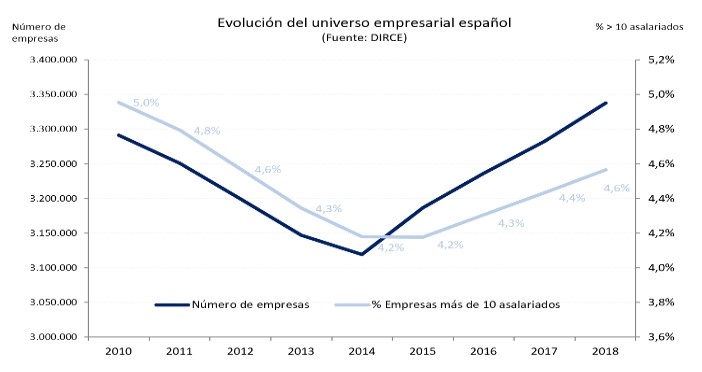
With an average of four employees per company, it is difficult to undertake internationalization processes and maintain regular foreign activity, i.e., for more than four consecutive years. In fact, although there has been a gradual increase in the number of SMEs and micro-SMEs participating in business travel since 2013, their presence is still relatively small and suggests opportunities for future growth,"says Marcel Forns Bernhardt, Director of GEBTA Spain and co-author of the study.
18% of current companies account for 83% of travel spending.
The actual universe of companies currently impacting the business travel market is excessively limited. Eighty-three percent of total travel spending is concentrated in companies with more than 20 employees (18% of the total), while companies with fewer than 10 employees (72%), the vast majority of our market, are only responsible for 11% of total spending.
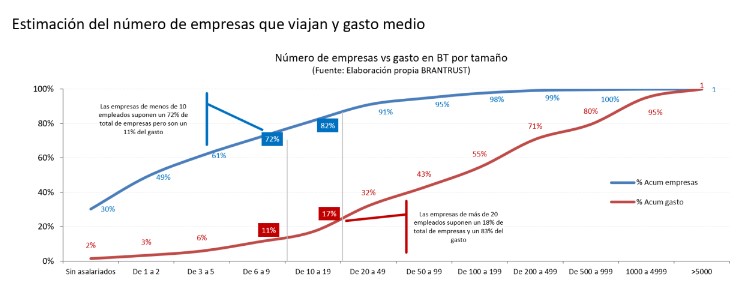
Sixty-seven percent of these companies with the most employees are concentrated in five autonomous communities, and 63% are concentrated in five main sectors, indicating that the Spanish productive market is highly concentrated.
Considering that growth projections for the business sector in 2025 are around 3.6 million companies, representing an approximate growth of 7%, the average size of companies will be a determining factor for business travel.
According to the forecasts contained in the study "2025, a look at the future of business travel," of this group of 3.6 million companies, approximately 5-6% will have more than 10 employees, with an average size slightly larger than at present.
Size matters, but it is not the only determining factor. Technology and specialization are key to optimizing travel investment.
To develop projections for business travel growth in Spain in 2025, the study conducted by GEBTA and BRAIN TRUST also analyzes contextual factors and the main economic variables that influence the business.
The way companies work will change radically, which will have a major impact on the management of their business travel. On the one hand, the way work and production processes are organized will undergo a 180-degree shift due to digitalization. Smaller, delocalized teams that are more demanding in terms of process speed will become the norm, and we will see a greater focus on people (employees, customers, partners, etc.).
The business travel sector will face a new profile of travel account managers who are much more accustomed to digital technology and the constant pressure to seek efficiency," says Ángel García Butragueño.
Travel agencies, which are constantly evolving, will have the mission of helping companies to optimally manage their travel, and therefore to be more competitive, supporting them in their efficiency and productivity, thus contributing to growing their businesses and improving their margins, through travel expense optimization programs, efficient and integrated processes, and the adoption of state-of-the-art technological tools.
Digitization and the use of specialists are key elements in ensuring the efficient use of the second item of indirect expenditure, while also ensuring adequate security and prevention policies.
Both elements are key for companies.
According to José Manuel Brell, Partner and Head of Quantitative Studies and Models at BRAINTRUST, and author of the study, "The trend suggests that by 2025, the business travel sector will consist of a set of integrated processes heavily reliant on technology, with fully automated flows where needs will be linked to business improvement and profitability. If tourism companies take the lead in this change, they will not only gain the advantage of being the promoters of change, but also the ability to steer this transformation towards the standards they consider most appropriate for their business, helping in their mission to digitize the Spanish business fabric and, with it, their competitiveness in an increasingly open, difficult, and complex market."
Possible scenario for business travel in Spain.
Depending on the combination of the various factors indicated—and without prejudice to the global environment—investment in business travel in Spain will range between €15 billion and nearly €16 billion in 2025. In a moderate scenario, the business travel sector will have grown by around 22% cumulatively, reaching €15.2 billion.
"The difference may seem insignificant in terms of relative annualized growth (around 3%), but if we consider that there is a correlation between investment in business travel and commercial activity, which currently stands at a ratio of 1:10 (10 euros for every euro invested in travel) and 1:6, depending on whether we are talking about exports or the domestic market, the gap between the lowest scenario and an optimal scenario of €16 billion could generate an impact equivalent to 0.5% of Spanish GDP," says Marcel Forns.
Conclusions and recommendations
The management of business travel in Spain by companies still has room for improvement. Good business travel management is essential for the growth of companies and, by extension, the economy as a whole.
In the case of Spain, the study "2025, a look at the future of business travel" conducted by GEBTA and BRAINTRUST highlights the existence of a great opportunity for improvement, which could lead to an increase in GDP (direct and indirect) of around 0.5%.
For the proper maturation of business travel in Spain, GEBTA and BRAINTRUST highlight the following basic recommendations:
- Regardless of how the global scenario evolves, Spanish companies must prepare themselves to compete in international markets under optimal conditions. The average size of companies in Spain suggests that it would be advisable to promote appropriate policies that foster the average growth of SMEs. Larger structures for small and medium-sized agencies are a basic requirement for tackling and maintaining business internationalization processes.
- Digitization is a key element in optimizing travel expenses, which on average represent the second largest indirect expense item. In general, Spanish companies need to rely on technology to make their processes more efficient, manage information properly, and improve their competitiveness. Without the right technology, not only is efficiency lost, but companies also run the risk of losing access to the best available rates.
- To promote digitization and efficiency in travel-related processes, companies are advised to seek guidance from specialized travel agencies. Outsourcing management is essential for containing costs and optimizing investments, but also for ensuring adequate security and prevention measures for travel and transportation.