

Some say that marketing has been severely affected by the COVID-19 pandemic. But if the "new normal" is teaching us anything in the business world, it is that marketing is more alive than ever. And no wonder: in a context of market constraints, both due to restrictions on traditional forms of interaction and the sharp slowdown in economic activity, companies are more in need than ever of developing and exploiting the best possible techniques to make an impact in a restricted market. Marketing may have a smaller budget, but it is more important than ever.
And if marketing is the new and essential language in the business world, this territory also has an accent that we at BRAINTRUST have been identifying and building since our early days: Customer Experience. We're not the ones saying it; it's according to the Marketing Hot Trends report, prepared for the Spanish Marketing Association by Garlic B2B and sponsored by Adobe. For the nearly 150 respondents who contributed to this document, Customer Experience is the main focus of marketing activity, which they rate 8.2 on a scale of 1 to 10 for its importance in their teams' tasks.
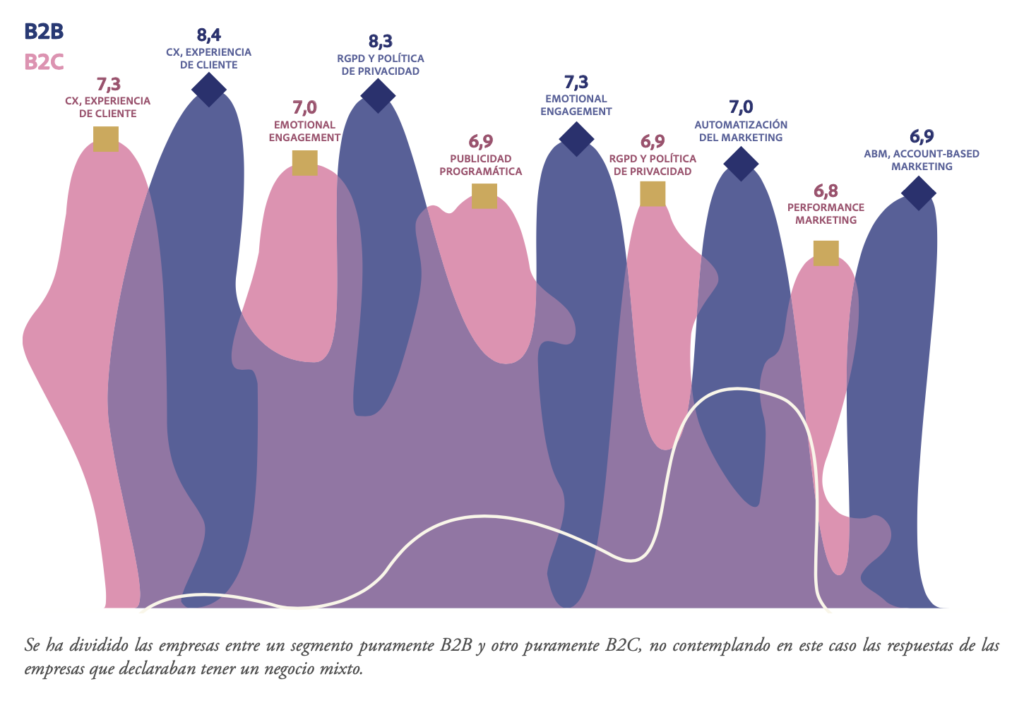
Importance of B2B/B2C. Image: B2B Committee
Customer Experience acts as a driving force, especially in smaller companies, while in larger companies it is only surpassed by a factor whose relevance is largely due to the need for regulatory compliance, such as data, privacy, and the General Data Protection Regulation (GDPR). If we stratify business activity according to its target market, both in the case of those aimed at the end consumer (B2C) and those aimed at businesses (B2B), Customer Experience is also the leading marketing trend. Furthermore, it is the undisputed leader in both investment and the capacity declared by the companies themselves to meet the challenges posed by this discipline.

Importance according to company size. Image: B2B Committee
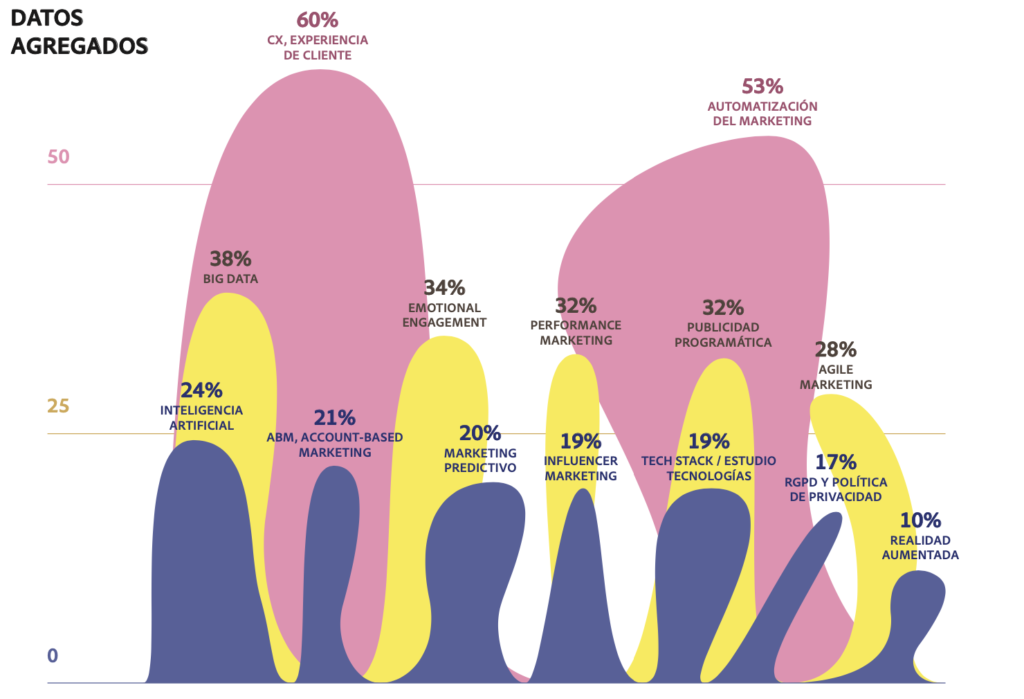
This leadership is significant because the survey published by the Spanish Marketing Association identified 14 wide-ranging trends for the 149 respondents, all of whom were directors or area managers in marketing departments of companies of different sizes and sectors. And these are not exactly 14 minor trends, as they include items as varied asperformance marketing, automation, the emergence of agile technologies, ABM (account-based marketing), programmatic advertising, artificial intelligence, and influencer marketing.
This overall ranking for Customer Experience partly explains the widespread importance given to what the study refers to asemotional engagement, i.e., the emotional commitment of consumers to brands and vice versa. Companies naturally assume that attracting, retaining, and expanding the market does not always and necessarily involve rational discourse, but rather must influence what truly "moves" their consumers. As is logical and natural, this trend is more prominent in small companies (2nd place) than in large ones (4th), as well as in B2C (2nd again) than in B2B (3rd); but in all cases it plays an important role.
Marketing investments. Image: B2B Committee
Also significant is the cross-study carried out using data from a similar survey for the United Kingdom, where the top two positions share the limelight, albeit in reverse order: first place goes to the GDPR and second place to Customer Experience. In the British report,emotional engagement drops to eighth place, and marketing automation (fourth place in the study for Spain) is the trend that completes this particular podium. It is also representative that in both cases augmented reality occupies the bottom position (last place) and that positions 10 to 13 are the same in both cases, although in different order. Thus,influencer marketing, predictive marketing, programmatic advertising, and artificial intelligence are, at present, the "poor relations" of marketing in both Spain and the United Kingdom.
The report was presented on October 7 during an online conference organized by the new B2B Marketing Committee, which included a round table discussion onemotional engagement. During the discussion, experts agreed that customer experience is fundamental in the B2B sector, as "we are in the age of experience," in which the goal is to ensure that customers have a "positive experience" that must "always be top-notch," according to information published on the Spanish Marketing Association's website.
A report that confirms our position as a specialist consultancy. Customer experience is a must for any company that wants to take itself seriously. And it must be an indelible hallmark of all marketing activity. Because yes, customer experience and marketing are more alive than ever. Even in times of COVID-19. Or, precisely because we are living in such complicated and uncertain times.
Header imageLeonardo Toshiro Okubo on Unsplash
Study images: B2B Marketing Committee MHT Study 2020
Prepared by: APP/EKMB/BTCS